
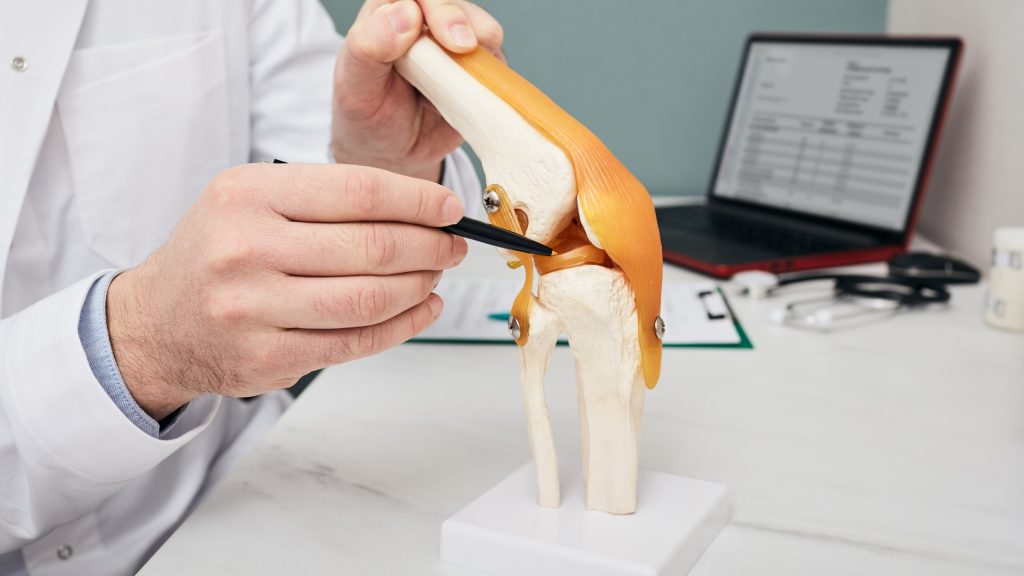
If your knee has been painful, swollen, or just not feeling right after an injury, you may be dealing with a meniscus tear. It is one of the most common knee injuries around, and according to research published by the National Institutes of Health, over 500,000 arthroscopic partial meniscectomies are performed in the United States every year, so if you are going through this, you are definitely not alone. At Valley Orthopedic Specialists in Connecticut, our team is here to help you understand what is happening with your knee and guide you toward the right path forward.
What Is the Meniscus and How Does It Tear?
Think of the meniscus as a shock absorber inside your knee. Your knee is made up of three bones: the thigh bone, the shinbone, and the kneecap, which sits at the front of the joint and helps protect it. Nestled between the thigh bone and shinbone are two C-shaped pieces of cartilage called the menisci, the medial meniscus on the inner side and the lateral meniscus on the outer side.
There are different types of meniscus tears, and understanding how a tear occurs can help make sense of your diagnosis. Acute meniscus tears happen suddenly, like twisting your injured knee during a game of basketball or soccer, taking a hard tackle, or landing awkwardly after a jump. This type of sports knee injury, sometimes called a traumatic meniscal tear, tends to affect younger, more active people. Common tear patterns include a bucket handle tear, a radial tear, a flap tear, and a longitudinal tear, each of which behaves differently and may require a different treatment approach
Degenerative meniscus tears, on the other hand, develop more gradually. As we get older, the cartilage in our knees naturally weakens, and sometimes even a simple movement like squatting down or getting up from a chair can be enough to cause a tear. Most meniscus tears in people over 40 fall into this category.
Either way, the result is the same: pain and swelling, discomfort, and a knee that does not feel like it is working the way it should. Left untreated, a damaged meniscus can also contribute to knee arthritis over time, which is one reason early meniscus tear treatment matters.
Signs You May Have a Meniscus Tear
Meniscus tear symptoms can range from mildly annoying to quite debilitating, depending on the size and location of the tear.
Pain along the side of the knee is usually the first sign. It might start as a dull ache and get sharper when you bend, squat, or go up and down stairs. Knee swelling after injury is also very common, often showing up within a day or two. The swelling happens because the knee joint fills with fluid as your body responds to the damage.
Many people also notice knee clicking and pain together, almost like something is catching or grinding inside the joint. This can feel unsettling, but it is a well-recognized sign of a meniscus injury. More significant is the knee locking symptom, where the knee gets stuck and you cannot fully straighten it. If this is happening to you, it is a sign that a piece of torn cartilage may be getting in the way of normal movement, and it is worth getting checked out sooner rather than later.
Some people also find that their knee feels unstable or like it might give way, especially when walking or going down stairs. If any of these symptoms sound familiar, it may be time to get a proper diagnosis.
How is a Meniscus Tear Diagnosed?
Getting to a torn meniscus diagnosis is usually a pretty straightforward process. Your doctor will start by asking you about your symptoms, when they started, and what makes them better or worse. They will also do a physical examination of the knee, using some simple movement tests to check for signs of a tear.
From there, you will likely have an X-ray to rule out any bone damage, followed by an MRI scan. The MRI is the most useful tool for looking at soft tissue like the meniscus. It gives a detailed picture of exactly where the tear is and how serious it is, all without any radiation. In some cases, the full picture only becomes clear once a surgeon looks inside the knee during a procedure, but this is not always necessary.
The sooner you get a clear diagnosis, the sooner you and your doctor can put a proper plan in place.
Meniscus Tear Treatment Options
Meniscus tear treatment is not one-size-fits-all. The right approach depends on the type of meniscus tear, your age, how active you are, and what your goals are. Many meniscus tears do not require surgery at all.
The Non-Surgical Route
Nonsurgical treatments are usually the first step for smaller or more stable tears, and for many people this is all they need. Conservative treatment typically starts with rest, ice, compression, and elevation to reduce swelling and manage knee pain. From there, physical therapy plays a central role, helping to strengthen the muscles around the knee, restore range of motion, and support the healing process. A structured rehabilitation plan guided by a physical therapist gives you the best chance of a full recovery without going ahead with surgery.
Over-the-counter anti-inflammatory medications can help relieve pain and manage swelling day to day. If inflammation is more stubborn, your doctor may recommend a corticosteroid injection directly into the knee to give you more significant relief. The goal throughout this process is to get the knee calm, build strength around it, and gradually return to normal knee function.
When Surgery May Be Required for a Meniscus Tear
If conservative treatment has not made enough of a difference after a few months, if you are experiencing the knee locking symptom, or if the tear is the kind that simply will not heal on its own, meniscus surgery may be the better option. Orthopaedic surgeons typically recommend surgery when the tear pattern, patient age, and activity level all point toward a surgical outcome being more beneficial than continued conservative care.
Arthroscopic surgery is minimally invasive, meaning the orthopedic surgeon works through very small cuts using a tiny camera and instruments. Arthroscopic knee surgery allows the surgeon to directly assess the knee condition and carry out the necessary repair with minimal disruption to surrounding tissue. There are two main approaches. Meniscal repair involves stitching the torn edges back together, preserving the natural cartilage and protecting the knee’s blood supply, which supports healing. Where the tear cannot be repaired, a partial meniscectomy removes the damaged part of the meniscus to relieve pain and restore knee motion.
Meniscal repair tends to produce better long-term outcomes because it preserves more of the natural tissue, though meniscus surgery recovery does take longer, typically four to six months for a repair compared to four to six weeks following a meniscectomy. In rare cases involving severe cartilage loss, an orthopaedic surgeon may discuss options such as a meniscus transplant or total knee replacement, though these are considered only when other options have been exhausted.
Your surgeon will talk you through which option fits your situation best.
What Does Recovery Actually Look Like?
Recovering Without Surgery
Most people following a non-surgical treatment plan start to feel significantly better within six to twelve weeks. The first couple of weeks are about managing pain and swelling. After that, physical therapy becomes the focus, gradually building strength and restoring normal movement. By the end of the process, most people are back to their regular activities, including sport and exercise, as long as they have put in the work during rehab.
Recovering After Surgery
Meniscus surgery recovery is more of a structured process, usually guided by a physical therapist. After a partial meniscectomy, most people are back to normal activities within six to twelve weeks. After a meniscus repair, it takes longer, typically four to six months before returning to sport, and sometimes a little beyond that for more physically demanding activities. The longer timeline is worth it, though, because repairing rather than removing the cartilage tends to mean better outcomes down the road.
Sticking to your rehab program and keeping your follow-up appointments are the two things that make the biggest difference in how well and how quickly you recover.
When Should You See an Orthopedic Specialist?
You do not need to tough it out and hope the pain goes away on its own. There are clear signs that it is time to see an orthopedic knee specialist. If your knee pain has lasted more than two weeks without improving, if swelling is not going down, if you are experiencing the knee locking symptom or a feeling of the knee giving way, or if you simply cannot put your full weight on it, it is time to get it looked at properly.
Valley Orthopedic Specialists serves patients across Connecticut with personalised, one-on-one knee care. Whether you need knee pain treatment without surgery or are considering arthroscopic knee surgery, our team will walk you through all available options.
If you are dealing with knee pain, swelling, clicking, or locking, reach out to the team at Valley Orthopedic Specialists and let us help you figure out what is going on and what to do about it.