

Staying active is good for your long-term health, but repeated impact puts pressure on the bones in your feet, ankles, and legs. Stress fractures are common injuries that often start quietly, especially for runners or anyone who has recently increased their activity level.
A stress fracture usually doesn’t come from one fall or misstep. It develops when repetitive stress outpaces the bone’s ability to recover. Early stress fracture symptoms may feel like a dull ache during exercise, mild swelling, or pain that keeps returning in the same area. Recognizing early warning signs makes it easier to get evaluated before the injury becomes harder to treat.
What Is a Stress Fracture?
A stress fracture is a tiny crack in a bone caused by repetitive force. Unlike traumatic fractures, which happen after a fall, collision, or single injury, stress fractures build over time.
Stress fractures are commonly linked to overuse and repetitive overload, especially when runners, athletes, or active individuals increase training too quickly.
Bone naturally responds to activity and when training increases too quickly, or when the same motion repeats without enough recovery, microscopic damage collects faster than the bone can repair itself. That stress reaction may eventually turn into a small crack.
Common Symptoms of a Stress Fracture
Stress fracture symptoms are easy to dismiss at first because the pain doesn’t usually feel severe right away. Many patients assume they are dealing with tight shoes, soreness, or a minor strain.
That’s why this type of pain should be taken seriously during evaluation, even when there isn’t an obvious injury. Careful listening, a focused physical exam, and the right imaging when needed can help identify whether the pain is coming from a stress fracture or another foot and ankle condition.
Common symptoms include:
- Pain that starts during exercise and improves with rest
- Tenderness over one specific area of bone
- Mild swelling near the painful spot
- Foot or ankle pain when walking, especially later in the day
- Pain that returns sooner each time you resume training
- A dull ache that becomes sharper with continued use
The biggest clue is often how concentrated the pain feels. Muscle soreness usually spreads across a larger area, while a stress fracture tends to hurt in a more defined spot. Pressing on that area may bring on acute pain.
Where Do Stress Fractures Happen Most Often?
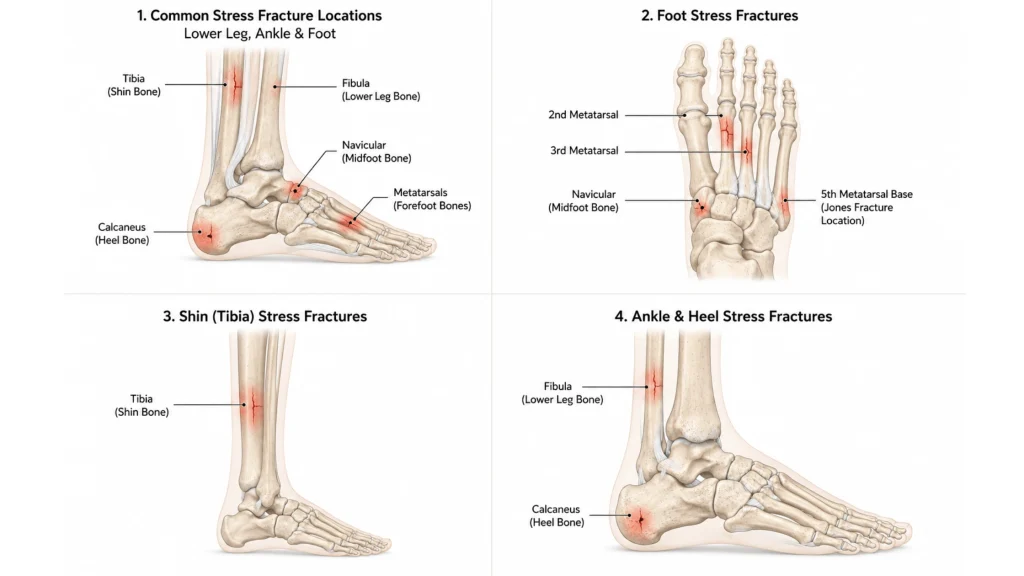
Stress fractures may develop in several areas. Foot, ankle, shin, and lower leg are common sites because they absorb repeated impact during sports. They often occur in weight-bearing bones of the lower leg and foot, which is why persistent pain in these areas should not be ignored.
Foot Stress Fractures
A foot stress fracture often affects the metatarsal bones, especially the second and third metatarsals. These bones carry a lot of force with each step, which makes them more vulnerable during running, jumping, or sudden training increases.
Navicular stress fractures, which affect a bone in the midfoot, need close attention because they may heal more slowly than lower-risk stress fractures. Jones fractures near the base of the fifth metatarsal also require careful evaluation.
Because foot pain can come from a wide range of conditions, a proper evaluation helps separate a stress fracture from issues such as plantar fasciitis, arthritis, tendon irritation, ankle sprains, or other foot and ankle injuries. The location of the pain, how it responds to rest, and whether it returns with activity all help give answers as to what to do next.
Shin Stress Fractures
The tibia, or shin bone, is another common stress fracture site. Shin stress fractures often affect runners and athletes who increase mileage, speed work, or training frequency too quickly.
This type of pain may start midway through a run, then appear earlier in each training session. Some shin stress fractures occur in high-risk locations, including the front part of the tibia, and need orthopaedic evaluation rather than continued training through the pain.
Ankle and Heel Stress Fractures
The ankle and heel can also absorb enough repeated impact to develop a stress injury. Calcaneal stress fractures affect the heel bone, while fibular stress fractures may cause pain along the outside of the lower leg or ankle.
If ankle pain lasts more than two weeks or keeps returning when you resume exercise, it’s time to get evaluated instead of cycling between rest and restart without answers.
Why Do Stress Fractures Develop?
These injuries happen when the bone absorbs more stress than it can recover from. In many cases, training changes, bone health, footwear, and movement mechanics all play a role.
Sudden Changes in Training
A sudden increase in mileage, speed, hills, practice time, or training frequency raises stress on the bones. Gradual training progression gives the body time to adapt. For many active people, increasing training load slowly is one of the most practical ways to prevent stress fractures.
For many active people, increasing training load slowly is one of the most practical ways to prevent stress fractures, especially when paired with adequate rest and recovery time.
Bone Health and Nutrition
Bone health plays an important role in stress injury risk. Low calcium intake, low vitamin D, poor nutrition, and low energy availability may reduce bone strength, especially when the body is regularly absorbing impact from running, sports, or long periods of activity.
Food, recovery, and training habits all affect how well bones respond to repeated stress over time. A healthy diet with adequate calcium, vitamin D, protein, and balanced nutrition supports
If someone has had more than one stress injury, develops pain after only a small change in activity, or has concerns about bone density, the evaluation looks beyond the painful area alone. In those cases, understanding bone health, training load, and recovery habits can be an important part of reducing the chance of another injury.
Worn-Out Shoes or Incorrect Footwear
Worn-out shoes lose cushioning and support. As that support breaks down, force may travel through the foot and ankle differently with each step.
Supportive footwear is especially important for runners and athletes in high-impact sports. If you run regularly, consider visiting a local running store or specialty shoe store for a proper fitting, especially if you’ve changed your mileage, terrain, or training routine. The right shoe should match your foot shape, activity level, and how your foot strikes the ground.
Replacing worn shoes before they lose support may reduce repetitive impact and lower the chance of stress injuries returning in the same area.
Foot Mechanics and Alignment
Flat feet, high arches, or changes in walking and running mechanics may shift stress toward certain bones. These factors may not cause pain right away, but over time they can contribute to stress reactions and stress fractures.
A sports medicine evaluation looks at the injury and the factors that may have contributed to it, including gait mechanics and training habits. A sports medicine evaluation looks at the injury and the factors that may have contributed to it, including gait mechanics, training habits, footwear, strength, and flexibility.
Low Baseline Activity Before a New Routine
Stress fractures also occur in people who begin a demanding exercise program after a long period of lower activity. Bones, muscles, and tendons need time to adjust to new loads, even when the person feels generally healthy or motivated to get back into shape.
A good starting point is to increase time, speed, or distance gradually rather than changing several things at once. For many people, increasing training by about 10% per week is a reasonable guide, although some athletes may need a slower pace depending on prior activity level, pain, footwear, and training surface.
Starting slowly and adding cross-training with lower-impact exercise, such as cycling or swimming, may reduce repetitive stress while maintaining fitness. If pain starts to return during the first few weeks of a new routine, that’s usually a sign to scale back rather than push through.
How Do Doctors Diagnose Stress Fractures?
Your physician will want to understand the pattern of pain before recommending treatment. That usually includes where the pain is located, when it started, what activities bring it on, and whether your training, shoes, or daily routine recently changed.
Physical Exam
During the physical exam, your physician will check for tenderness, swelling, range of motion, and the exact area of pain. Pain over a defined area of bone often raises concern for a stress fracture.
The exam also helps separate a possible stress fracture from other common foot and ankle problems, such as plantar fasciitis, Achilles tendinitis, ankle sprains, tendon irritation, or arthritis.
Imaging Tests, X-Rays, MRI Scans, and Bone Scans
Imaging tests may confirm the diagnosis, but timing affects what the results show.
X-rays may not show a stress fracture during the first couple of weeks. A normal early X-ray doesn’t rule out a stress injury.
MRI scans are often the best option when early diagnosis matters because they can detect stress fractures before they appear on an X-ray. Bone scans may also show areas of increased bone activity, although they involve radiation exposure and are less specific than MRI.
How Are Stress Fracture Treated?
Stress fracture treatment depends on the bone involved, the fracture site, the severity of the injury, and the patient’s activity level. Most low-risk stress fractures heal with proper rest and activity modification, but not all stress fractures follow the same course.
Activity Modification and Proper Rest
Most stress fractures treated without surgery require a period of reduced activity. This usually means avoiding impact exercise until the injured bone has had time to heal.
Depending on the location, treatment may include:
- Activity modification
- A walking boot
- Crutches or temporary weight-bearing restrictions
- Pain management guidance
- Cross-training with low-impact exercise
- Gradual return to activity once symptoms improve
Many low-risk stress fractures heal in about six to eight weeks, although recovery varies by location and severity.
Physical Therapy and Return to Activity
Physical therapy often becomes important once the painful phase improves. Therapy may focus on strength, balance, flexibility, gait mechanics, and a safe return to walking, running, work, or sport.
A good recovery plan should also address the factors that may have contributed to the injury, such as training schedule, footwear, strength, or movement mechanics. Valley Orthopaedic Specialists offers physical therapy in Connecticut for patients recovering from orthopaedic injuries and treatment.
High-Risk Fractures
High-risk fractures need closer monitoring because they have a greater chance of delayed healing or progression. These may include navicular stress fractures, Jones fractures, and certain tibial stress fractures.
In some cases, internal fixation or another surgical treatment may be recommended to protect healing and prevent a major setback. An orthopaedic specialist can explain whether surgery is necessary based on the fracture site, imaging results, and symptoms.
When Should Persistent Pain Be Evaluated?
Not every ache after a hard workout means you have a stress fracture, but persistent pain should not be ignored when rest no longer settles it or walking starts to feel uncomfortable.
An orthopaedic evaluation is recommended if pain keeps returning after you restart training, swelling appears near the painful area, or you have a history of stress fractures or low bone density. Recent changes in mileage or training intensity may also point to a stress injury that needs evaluation.
Early diagnosis is important because continuing to train on a stress fracture may make the injury worse. A small stress injury may progress to a more serious fracture if the bone doesn’t get enough time to heal.
Stress Fracture Evaluation in Shelton, Oxford, and Fairfield, CT
Stress fracture symptoms often start quietly, but the pattern is usually recognizable. Pain that builds with activity, settles with rest, and returns in the same area should be taken seriously.
If pain in your foot, ankle, shin, or heel keeps returning with activity, Valley Orthopaedic Specialists can evaluate your symptoms, confirm the diagnosis, and recommend the right treatment. Our team provides orthopaedic care in Shelton, Oxford, and Fairfield, CT, including foot and ankle evaluation, sports medicine, on-site imaging, physical therapy, and OrthoDirect urgent orthopaedic care.
Contact Valley Orthopaedic Specialists to schedule an appointment and take the next step toward a safe return to activity.