
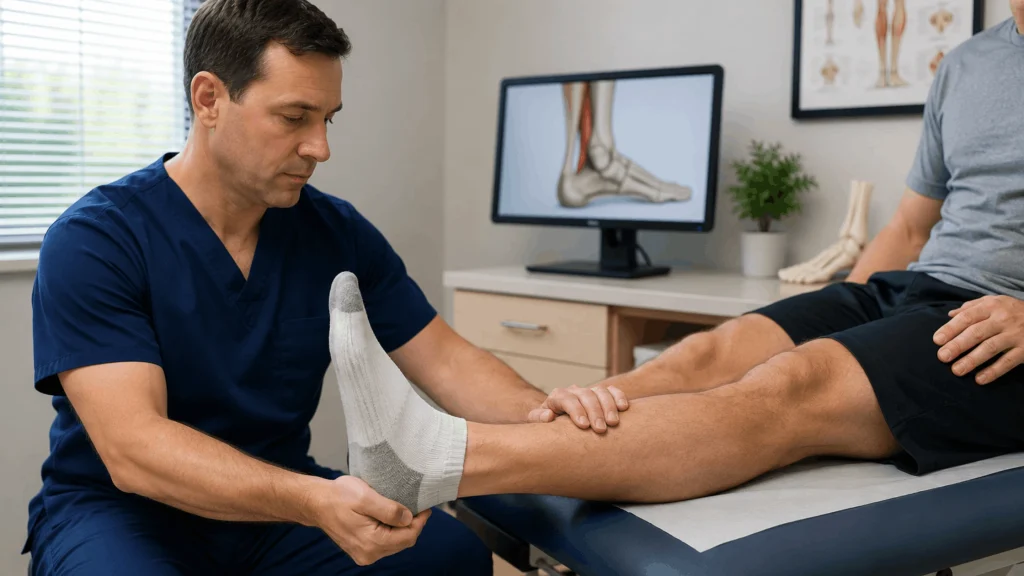
An Achilles tendon rupture usually happens suddenly, often during sports that require a quick push-off or change in direction. Many people feel sudden, sharp pain in the back of the ankle or calf and may hear or feel a pop when the tendon tears.
A rupture needs early medical evaluation because a complete tear requires a different plan than a strain, tendonitis, or mild overuse injury. Depending on the severity of the tear, treatment may involve immobilization in a boot or cast, structured rehabilitation, or surgery to repair the tendon. A foot and ankle specialist can examine the injury, confirm the diagnosis, and recommend treatment based on the severity of the tear, activity level, and recovery goals.
What Happens When the Achilles Tendon Tears?
The Achilles tendon connects the calf muscles to the heel bone and allows the foot to push off the ground during walking, running, climbing stairs, and standing on tiptoe.
An Achilles tendon tear involve a partial tear or a complete rupture. A partial tear means some tendon fibers remain intact, while a complete rupture means the torn tendon separates enough that it no longer works normally.
These injuries often affect active adults, especially people who play sports, such as tennis, basketball, pickleball, running, or other activities that involve sprinting, jumping, pivoting, or sudden stops.
What Are the Most Common Achilles Rupture Symptoms?
Achilles rupture symptoms often appear at the moment the injury occurs. Some patients feel intense pain first, then notice weakness more than pain later, while others aren’t able to walk normally or climb stairs comfortably.
Common torn Achilles symptoms include:
- A sudden pop or snap in the back of the ankle or calf
- Sharp pain near the heel or lower leg
- Swelling or bruising around the back of the ankle
- Trouble walking normally or pushing off the injured foot
- Difficulty standing on tiptoe
- A limp after a sudden calf pain injury
- A gap or soft spot in the tendon area
Symptoms may also vary based on where the tendon injury occurs. A heel tendon injury may cause symptoms just above the heel bone, along the back of the ankle, or higher in the lower leg. Because calf strains, tendonitis, ankle sprains, and ruptures can overlap, an orthopaedic evaluation gives patients an accurate diagnosis and treatment plan.
How Is a Rupture Different From Tendonitis or a Strain?
Achilles pain does not always mean the tendon has ruptured. Tendonitis, strains, and ruptures may all cause pain near the heel or lower leg, but they do not require the same treatment.
Achilles tendonitis usually develops from irritation or overuse. It’s described as stress-related inflammation that causes pain along the tendon or near the back of the heel. Symptoms often build gradually and may feel worse after physical activity.
Tendonitis usually refers to longer-term tendon changes rather than an acute tendon rupture. A calf strain affects the muscle or the area where the muscle and tendon meet, which may cause tightness during activity, but many people can still push off the injured foot.
A rupture usually feels more sudden, so many patients describe it as a snapping sensation, a pop, or a feeling that someone kicked them in the back of the ankle. The pain may settle after the first few minutes, but weakness and difficulty walking often remain.
How Do Orthopaedic Specialists Diagnose a Rupture?
An orthopaedic specialist will ask when the pain began, what movement caused it, whether there was a pop or snapping sensation, and whether the injured foot can still push off the ground.
The physical examination focuses on how the tendon feels and functions, so the specialist may look for swelling or bruising, check for a gap in the tendon, compare both legs, and evaluate ankle motion. They may also use the Thompson test, which involves gently squeezing the calf to see how the foot responds. NCBI’s StatPearls review reports that a positive Thompson test has high sensitivity and specificity for Achilles rupture.
Imaging tests may support the diagnosis when the exam findings are unclear or when the specialist needs more detail before recommending treatment. Ultrasound or magnetic resonance imaging may show the location and severity of the tendon tear. X-rays do not show the Achilles tendon itself, but they may help rule out related bone injuries.
What Are the Treatment Options?
Treatment depends on the severity of the tear, how far the torn tendon has separated, the patient’s health, activity level, timing of diagnosis, and recovery goals. Small partial tears may respond well to nonsurgical treatment, while complete ruptures may require either nonsurgical care or surgery, depending on the patient and injury.
The best option requires a direct conversation with an orthopedic foot specialist. A patient who wants to return to high-demand sports may need a different plan than a patient who wants to restore comfortable walking and daily movement.
Nonsurgical Treatment
Nonsurgical treatment keeps the foot and ankle positioned so the torn tendon can heal. This plan often uses a cast, brace, or walking boot with the foot angled downward early in recovery. The care team then adjusts the position over time as healing progresses.
Nonsurgical treatment may suit some patients, especially when the torn tendon has not separated too far, and the patient’s activity goals align with this approach. It avoids surgical risks, but it still requires careful follow-up, bracing, and physical therapy to restore strength and range of motion.
Achilles Tendon Surgery and Repair
During achilles tendon repair, the surgeon stitches the torn tendon together so it can heal in a stronger position. The exact technique depends on the tear pattern, tendon quality, timing of injury, and surgeon judgment.
Surgery often serves active, middle-aged, or younger patients, while physical therapy remains part of recovery, whether a patient receives surgical or non-surgical treatment.
Surgical options may include open repair or minimally invasive surgery. In an open repair, the surgeon makes a larger incision to reach the torn Achilles tendon. Minimally invasive techniques use smaller incisions to repair the injured tendon. Surgical repair may lower the risk of re-injury for some patients, but surgery also carries risks such as stiffness and nerve injury.
What Does Recovery Usually Involve After Surgery?
After surgery, recovery takes time because tendons heal gradually. Patients usually move through phases rather than one fixed schedule. The care team may begin with immobilization, then progress to protected weight bearing, range of motion, progressive strengthening exercises, balance work, and activity-specific training when appropriate.
A typical Achilles recovery timeline starts with protection in a splint, cast, or boot while pain and swelling decrease. Once the specialist allows, the patient may begin early weight bearing in a boot and later move into functional rehabilitation.
The American Acadamy of Orthopaedic Surgeons notes that complete recovery may take about 12 months or longer. Some patients need closer to two years to reach all of their goals. Recovery timing depends on the injury, treatment plan, patient health, and rehabilitation progress.
Physical therapy often becomes part of recovery once the tendon has enough protection and healing time. Guided rehabilitation can address ankle motion, calf strength, walking mechanics, and balance as activity gradually increases.
Patients can support recovery by wearing the boot, brace, or cast exactly as directed and keeping follow-up appointments. They should report new pain, swelling, drainage, numbness, or calf symptoms instead of waiting to see whether symptoms improve.
What Causes This Type of Tendon Injury?
An Achilles tendon rupture usually occurs when the tendon absorbs more force than it can tolerate. This often happens during a quick, forceful movement rather than steady walking.
Common causes and risk factors include:
- Sprinting, jumping, landing, or pivoting
- A sudden increase in training intensity
- Returning to activity after time away
- Prior Achilles tendon pain or Achilles tendinopathy
- Tight calf muscles or limited ankle range of motion
- Certain medical factors or medication history, which your clinician should review
Most Achilles tendon injuries occur during activity, but not every rupture comes with warning signs. Some patients have no major achilles pain before the injury, while others remember earlier tightness or soreness.
A sports injury ankle evaluation often looks beyond the tendon alone. The orthopaedic specialist may review calf strength, ankle motion, foot structure, training habits, prior tendon pain, and the patient’s sports demands.
Who Has a Higher Risk of an Achilles Tendon Tear?
These ruptures often occur in active adults who play recreational sports, although the injury can happen to anyone. The peak age for Achilles tendon rupture is 30 to 40 and that Achilles tendon injuries occur most often during sports.
Certain medications and health conditions may increase the risk in some patients. National Center for Biotechnology Information’s StatPearls review discusses risk factors such as athletic activity, prior tendon disease, steroid exposure, and fluoroquinolone antibiotics.
Bone spurs, prior Achilles tendinosis (longer-term tendon changes rather than an acute tear), and long-term tendon damage may increase risk. Although these factors don’t mean a rupture will happen, they can influence diagnosis, treatment planning, and recovery expectations. Patients should review their medical history with their specialist instead of assuming one factor caused the injury.
Foot and Ankle Care for an Achilles Rupture
An Achilles tendon rupture needs timely diagnosis and a treatment plan that matches the injury and the patient’s activity goals. A strain, tendonitis, and complete rupture may all cause pain near the heel or calf, but they require different next steps.
Valley Orthopaedic Specialists provides foot and ankle evaluation, surgical and non-surgical treatment options, on-site imaging, and rehabilitation resources for patients in Shelton, Oxford, and surrounding Connecticut communities. If you notice sudden pain, a pop, weakness, or other torn Achilles symptoms, schedule an appointment with our team for an evaluation.