
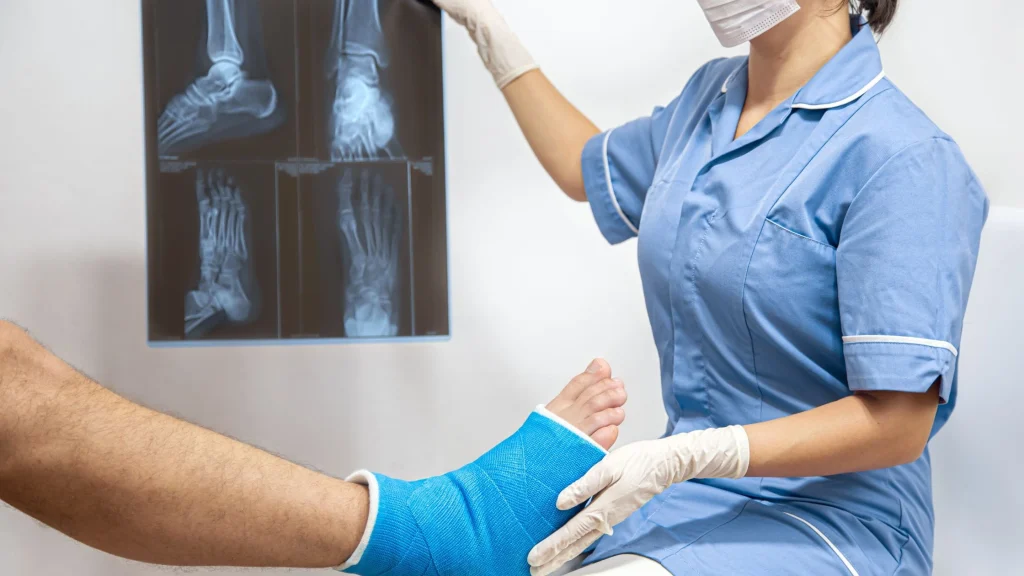
It counts when something hurts badly enough to stop you in your tracks. It’s difficult to know whether you need an ambulance, an orthopedic walk-in clinic, or just some rest when something hurts. Swelling, bruising, and even pain doesn’t always confirm whether something is broken or not.
However, an orthopedic emergency is any bone, joint, or soft tissue problem that needs same-day attention to prevent it from getting worse. Knowing when to get care and where to go for treatment directly affects how quickly you recover.
When Is an Injury Urgent Enough for Same-Day Orthopedic Care?
Not every painful injury needs a hospital emergency room, but waiting too long can make certain bone, joint, or soft tissue injuries harder to treat. The challenge is knowing whether the injury needs emergency care, same-day orthopedic evaluation, or a short period of rest and monitoring.
A useful first question is whether the injury appears unstable or severe. Visible deformity, loss of feeling, circulation changes, heavy bleeding, an open wound near the injury, or a joint that looks fully out of place should be treated as emergency room concerns. These situations may involve trauma, circulation problems, or complications that need hospital-level care.
Other injuries are still urgent, even if they don’t require the ER. A swollen ankle after a fall could be a sprain, a hairline fracture, or a more serious break. A wrist injury after catching yourself during a fall may look mild at first but still need X-rays. That’s why same-day orthopedic evaluation can be the right setting for painful but stable injuries involving the bones, joints, muscles, tendons, or ligaments.
Bone fractures range from stable cracks where the bone stays in place to compound breaks where it pierces the skin, and the treatment for each is very different.
What Are The Common Symptoms Of Orthopedic Injuries?
A fully broken bone often causes severe pain, swelling, bruising, and difficulty using the injured area. Still, symptoms alone don’t always show how serious the injury is. A smaller crack in the bone, ligament tear, or joint injury can also cause significant pain, and X-rays or an orthopedic exam may be needed to understand what happened.
Some signs point more clearly to an injury that needs medical attention today:
- Bone visible through the skin, known as an open or compound fracture
- Obvious deformity, such as a limb that looks bent, shortened, or angled in a way it shouldn’t be
- Numbness, tingling, or loss of feeling below the affected area
- Complete inability to put any weight on a leg or foot after a fall or impact
- A joint that looks completely out of position or has visibly dislocated
- Rapidly worsening swelling with skin that’s turning pale or blue
Most of these symptoms mean you should go to the emergency room immediately. For painful but stable injuries without signs of major trauma, same-day orthopedic evaluation may be more appropriate.
Should You Go To The Emergency Room or Orthopedic Urgent Care?
This is where patients most often get it wrong, and it’s not their fault. The decision comes down to whether the problem is stable and clearly orthopedic in nature, or whether it involves something more serious, like heavy bleeding, a head or spine concern, or damage to internal organs.
When Should You Go To The Emergency Room?
Go to the emergency room immediately if the bone has broken through the skin, there’s heavy bleeding that won’t stop, you lost consciousness, you suspect a spine or pelvis problem, the affected limb feels cold and looks pale, or the situation follows a serious accident such as a car crash or a fall from height.
These are cases where emergency care requires the trauma team and surgical capability that only a hospital emergency room carries.
When Is Orthopedic Urgent Care The Right Call?
When the problem is clearly a bone, joint, or soft tissue concern and you’re otherwise stable. A painful, swollen ankle after a bad step, wrist that took the impact of a fall, knee pain after a sports collision, shoulder pain following a dislocation that went back into place. orthopedic urgent care is built for exactly these situations, with on-site X-rays, splinting, bracing, and casting all available in a single visit.
If the pain is bad but manageable without emergency intervention, that’s often when an orthopedic urgent care clinic is the better option over an emergency room visit.
What To Expect When You Walk Into OrthoDirect In Connecticut
OrthoDirect is Valley Orthopaedic Specialists’ dedicated orthopedic urgent care service, staffed by orthopedic surgeons and orthopedic-trained physician assistants. It’s not a general urgent care clinic where the same room handles colds and broken bones. The doctors here focus exclusively on bone, joint, and soft tissue conditions.
When you walk in, an orthopedic physician evaluates you right away. On-site X-rays mean you get a diagnosis without leaving the building. If the problem needs a splint, cast, or brace, that’s taken care of on the same visit, along with a clear treatment plan for what comes next. If a bone fracture turns out to need surgical intervention, you’re already inside a specialist practice that coordinates that directly, rather than sending you out for a referral.
Compared to an emergency room visit, urgent care through OrthoDirect typically means shorter wait times, more affordable out-of-pocket costs, and patient care from orthopedic specialists focused exclusively on bone and joint conditions with no appointment is needed.
What Can Orthopedic Urgent Care Treat?
Most bone, joint, and soft tissue problems that don’t involve open wounds or major trauma can be handled at an orthopedic walk-in clinic. Common orthopedic injuries seen through fracture care urgent care include:
- Ankle and foot: sprains, suspected broken bones, Achilles tendon pain, heel pain, and stress fractures
- Knee: meniscal tears, ACL damage, kneecap instability, and sudden swelling after a sports collision
- Hand and wrist: bone fractures, sprains, trigger finger, carpal tunnel flares, and tendon problems
- Shoulder and elbow: rotator cuff strains, shoulder impingement, tennis elbow, and biceps tendon damage
- Sports-related injuries: muscle strains, ligament damage, minor fractures, and sudden joint pain in active patients at any age
Bone and joint problems fall into acute and overuse categories, and both benefit from early evaluation. A severe ligament tear left untreated can lead to lasting joint instability and chronic pain that’s far harder to manage months down the line.
Sports-related injuries are also an area where an orthopedic walk-in clinic outperforms a general urgent care center. A non-specialist may not recognize the difference between a partial ligament problem and a complete tear. The treatment for each is very different, so it’s important to know what the injury actually is.
An orthopedic walk-in clinic can evaluate the injury, order X-rays when needed, and decide whether bracing, splinting, physical therapy, specialist follow-up, or additional imaging should be considered.
Should You Schedule a Follow-Up With An Orthopedic Doctor?
Same-day care at an urgent care clinic is often the start of the process, not the end. Some conditions need a follow-up appointment within a few days, others within the week. You’ll likely need to schedule a follow-up if:
- X-rays show a bone fracture that may need surgical intervention or more involved stabilization
- Symptoms don’t improve within 48 to 72 hours of your initial urgent care visit
- You’re an athlete or worker who needs a formal return-to-play or return-to-work evaluation
- You’re dealing with ongoing joint instability after the acute phase
- Physical therapy is part of getting you back to full recovery
If something that initially looks like a minor fracture turns out to be more serious, your orthopedic care doesn’t start from scratch. The same practice manages your X-rays, follow-up appointments, and any additional treatment needed. Patients seen at OrthoDirect who need ongoing specialist care can move directly through the Valley Orthopaedic Specialists specialist network without repeating the process elsewhere.
Know Where to Go When an Orthopedic Injury Can’t Wait
An orthopedic emergency is any bone, joint, or soft tissue problem that needs same-day care to stop the situation from getting worse. Open fractures, complete dislocations, loss of circulation or feeling, and major deformity require an emergency room visit. Suspected broken bones, painful swollen joints, acute sprains and strains, and stable sports-related injuries belong at an orthopedic urgent care clinic, where orthopedic specialists evaluate and treat them from the start.
Getting that call right keeps you out of unnecessary emergency room wait times and puts you in front of the right doctors faster.For a recent injury that needs same-day attention, OrthoDirect at Valley Orthopaedic Specialists offers walk-in orthopedic evaluation in Shelton and Oxford. No appointment is needed. Patients can call 203-734-7900 with questions about timing, availability, or where to be seen. Additional orthopedic care is also available through the Fairfield office.